I study how design knowledge is built and utilized by designers, how ethical consequences result from designed systems, and how designers learn to act with judgment in complex settings.
My research connects design theory, human-computer interaction, professional user experience practice, education, and legal and regulatory perspectives. These three areas are distinct but deliberately intertwined.
ILLUMINATING THE FUNDAMENTALS OF DESIGN
Design Theory and Methods
How does design knowledge become actionable without being reduced to a checklist? How are methods created, improvised upon, and socialized?
I study the forms of knowledge and judgment that make design action possible: methods and meta-methods, competence, and identity, among others. A central goal is to make the structure and language of design knowledge more precise while preserving its contextual, reflective, and performative character.
Selected papers
DRS 2026
Gray, Chivukula, & Asad
Toward an Architectural Model of Design Methods
A philosophy paper that distinguishes meta-methods, proto-methods, and method building blocks—contributing to an expansion in the vocabulary scholars can use to describe methods knowledge.
Design Studies 2022
Gray
Languaging Design Methods
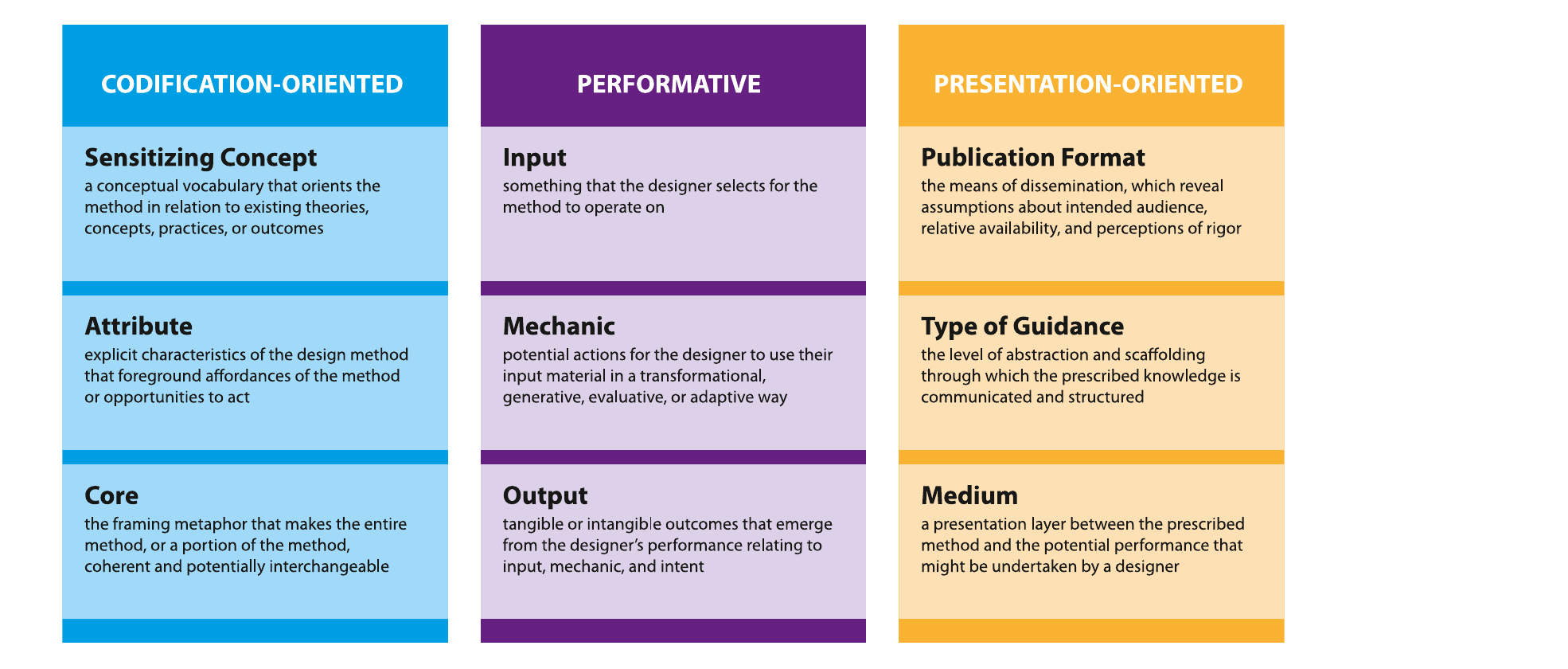
A philosophy paper that leverages a collection of ethics-focused methods to build a “language” for methods. I propose a vocabulary across three stances: prescription, performance, and presentation orientation.
Designing 2025
Gray
Designing in Context
An editor perspective that reconnects design theory with the situated realities of practice and education, proposing an ecological view of design knowledge, design praxis, and the actors involved in this ecosystem.
Questions that shape my design theory and methods work
Across my research in design theory and methods, I keep returning to a set of overlapping questions:
How can methods be structured without becoming recipes?
This question examines how design methods become meaningful and actionable without being reduced to portable recipes. Across this work, I have developed increasingly precise ways to describe how methods are structured, languages, interpreted, adapted, and performed in context.
- Toward an Architectural Model of Design MethodsGray, Chivukula, & Asad · DRS, 2026
- Organizing Metaphors for Design MethodsPivonka, Makary, & Gray · International Journal of Technology and Design Education, 2024
- Languaging Design MethodsGray · Design Studies, 2022
- It’s More of a Mindset Than a MethodGray · CHI, 2016
How do designers act when methods are not enough?
This work examines the forms of judgment that enable designers to frame problems, navigate competing considerations, and reflect on the consequences of their decisions when methods do not determine a clear course of action.
- Building an Ethics-Focused Action PlanGray et al. · CHI, 2024
- Developing Framing Judgment AbilityParsons et al. · EduCHI, 2023
- Design Judgment in Data Visualization PracticeParsons et al. · IEEE VIS, 2020
- Designers’ Articulation and Activation of Instrumental Design Judgements in Cross-Cultural User ResearchGray & Boling · CoDesign, 2018
How does professional design knowledge develop?
I examine how UX practitioners acquire, share, and transform professional knowledge. Rather than treating competence as a stable collection of knowledge, this work traces how identities, communities, and evolving forms of practice shape what designers know and how they act.
- A Practice-Led Account of the Conceptual Evolution of UX KnowledgeKou & Gray · CHI, 2019
- Co-Producing, Curating, and Defining Design Knowledge in an Online Practitioner CommunityGray & Kou · CoDesign, 2019
- Flow of Competence in UX Design PracticeGray, Toombs, & Gross · CHI, 2015
- Evolution of Design Competence in UX PracticeGray · CHI, 2014
How does design knowledge appear and spread?
I consider how design knowledge is created and shared through precedents, cases, narratives, and acts of critique. This work explores how designers interpret prior work, communicate situated knowledge, and develop shared understandings through discussion and reflection.
- Historical Instructional Design CasesBoling, Gray, Howard, & Baaki, eds. · Routledge, 2021
- Markers of Quality in Design PrecedentGray · International Journal of Designs for Learning, 2020
- Use of Precedent as a Narrative Practice in Design LearningBoling & Gray · Educational Technology and Narrative, 2018
- Supporting Distributed Critique Through Interpretation and Sense-MakingKou & Gray · Proceedings of the ACM on Human-Computer Interaction, 2017
How does design knowledge move across research and practice?
This question examines how knowledge moves—or fails to move—among researchers, educators, practitioners, and policymakers. The work seeks to understand the people, concepts, and translational practices that connect different knowledge communities without erasing their distinct priorities.
- How Is “Public Policy” Used in HCI Scholarship?Gairola & Gray · CHI Extended Abstracts, 2025
- In Search of UX TranslatorsBrier, Gray, & Kou · DIS Companion, 2017
- UX Practitioners’ Engagement with Intermediate-Level KnowledgeGray & Kou · DIS Companion, 2017
- Reprioritizing the Relationship Between HCI Research and PracticeGray, Stolterman, & Siegel · DIS, 2014
CONSIDERING THE IMPACT OF DESIGN
Design Ethics and Dark Patterns
How do designed systems undermine user choice, shape consent in problematic ways, and distribute harm?
I investigate deceptive, coercive, and manipulative practices across interfaces and experiences. This work develops a shared language for identifying dark patterns, rigorous methods for tracing them over time, and frameworks that connect evidence with business models, law, regulation, and socio-technical context.
Selected papers
CHI 2026
Gray
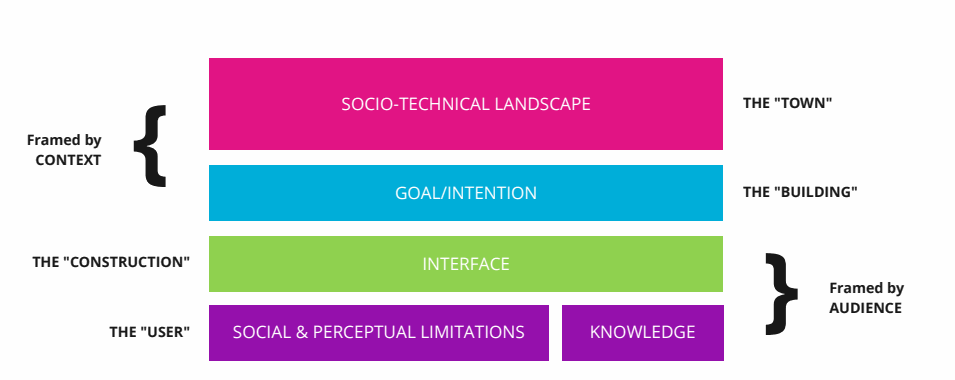
The Dark Patterns Knowledge Stack
The stack draws on Alexander’s pattern language to link interface evidence to business models. This approach aligns user characteristics, organizational goals, and legal concerns.
CHI 2025
Gray, Mildner, & Gairola
Getting Trapped in Amazon’s “Iliad Flow”
Temporal Analysis of Dark Patterns (TADP) is a novel method for analyzing dark patterns across a user journey, including intra-, inter-, and system-level scales of analysis.
CHI 2024
Gray, Santos, Bielova, & Mildner
An Ontology of Dark Patterns Knowledge
This ontology harmonizes academic and regulatory taxonomies, providing a robust relational and definitional foundation for dark patterns scholarship and enforcement.
Questions that shape my design ethics and dark patterns work
Across my research in design ethics and dark patterns, I am continually asking and refining questions about how deceptive, manipulative, and coercive systems are described, experienced, produced, and regulated. These questions continue to evolve as dark patterns practices—and the responses to them—change.
How can we build and sustain a shared language of dark patterns?
This work develops knowledge structures that help researchers, practitioners, and regulators identify dark patterns and reason about them across disciplinary boundaries.
- The Dark Patterns Knowledge StackGray · CHI, 2026
- An Ontology of Dark Patterns KnowledgeGray et al. · CHI, 2024
- Mapping the Landscape of Dark Patterns ScholarshipGray et al. · DIS Companion, 2023
- When Does Manipulation Turn a Design “Dark”?Gray & Chivukula · Interactions, 2020
How do dark patterns unfold over time and across user journeys?
Rather than treating dark patterns as isolated interface elements, this work examines how manipulation accumulates across interactions, changes over time, and connects interface choices with larger organizational systems.
- Getting Trapped in Amazon’s “Iliad Flow”Gray, Mildner, & Gairola · CHI, 2025
- Tracing the History and Evolution of Dark Patterns on Twitter from 2010–2021Obi et al. · ACM Transactions on Social Computing, 2025
- Temporal Analysis of Dark PatternsGray, Mildner, & Bielova · arXiv, 2023
- Co-Evolving Towards Evil Design OutcomesChivukula & Gray · DRS, 2020
How do designers recognize and act on ethical concerns in practice?
I examine the identities, organizational conditions, methods, and forms of language that shape ethical awareness and action in everyday design work.
- Languaging Ethics in Technology PracticeGray et al. · ACM Journal on Responsible Computing, 2024
- Scaffolding Ethics-Focused Methods for Practice ResonanceGray et al. · DIS, 2023
- Identity Claims That Underlie Ethical Awareness and ActionChivukula et al. · CHI, 2021
- Dimensions of UX Practice That Shape Ethical AwarenessChivukula et al. · CHI, 2020
How can design evidence support law, regulation, and enforcement?
This work connects design research with legal and regulatory questions, including how consent should operate, how evidence can be collected and characterized, and how practitioners understand their relationship to law.
- Usable and Lawful: Can Consent Be Both?Santos et al. · Information & Communications Technology Law, 2026
- Leveraging Interdisciplinary Methods for Evidence Collection in EnforcementGunawan et al. · Internet Policy Review, 2025
- Legal Trouble? UX Practitioners’ Engagement with Law and RegulationGray et al. · DIS Companion, 2024
- Dark Patterns and the Legal Requirements of Consent BannersGray et al. · CHI, 2021
How are manipulative systems experienced as harm?
I also investigate how people experience manipulation in everyday use, with particular attention to social media, teenagers, privacy and safety settings, and the cumulative effects of platform design.
- “Social Media Killed Our Generation”Gairola et al. · CHI, 2026
- Clicks, Screens, and ControlDong et al. · CHI Extended Abstracts, 2026
- “My Mother Told Me These Things Are Always Fake”Chamorro, Lallemand, & Gray · DIS, 2024
- End User Accounts of Dark Patterns as Felt ManipulationGray et al. · Proceedings of the ACM on Human-Computer Interaction, 2021
SUSTAINING AND EVOLVING DESIGN PRACTICE
HCI and Design Education
How do designers learn to work in a volatile and uncertain design discipline such as UX design? How do they gain the skills to navigate the complexity of practice?
I investigate how students develop design judgment and professional competence, share guidance on structuring studio learning experiences, and consider how HCI programs can prepare students to work across disciplinary and cultural boundaries.
Selected papers
EduCHI 2026
Asad & Gray
Wrangling and Supporting Uncertainty
This paper develops an affective account of how educators and students experience uncertainty, leveraging the Crismond and Adams Informed Design Matrix to reveal how uncertainty impacts designer performance across a range of design moves.
EduCHI 2024
Gray & Toombs
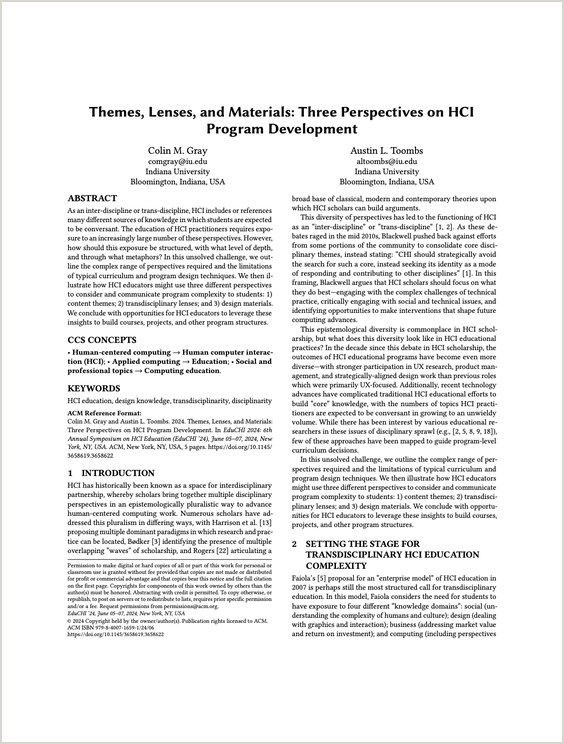
Themes, Lenses, and Materials
This paper offers three complementary perspectives for developing HCI curricula and programs. Content themes guide the knowledge students engage with; transdisciplinary lenses offer perspectives for activation; and design materials structure design action.
Book 2025
Jones et al.
Studio Properties
A field guide to studio education that makes its contextual and entangled properties visible, helping educators and researchers understand studio pedagogy. This collection of 57 properties provides an expansive view of the complexity of studio educational practices.
Questions that shape my HCI and design education work
Across my research in HCI and design education, I ask questions about how designers learn, form professional identities, develop judgment, and work across disciplinary and cultural boundaries. These threads connect classroom practices with the larger structures and expectations of design education.
How can studio environments sustain learning and professional identity?
This work examines the design studio as a complex learning environment in which spaces, relationships, activities, and expectations shape how students learn to act and communicate as designers.
- Studio Properties: A Field Guide to Design EducationJones et al. · Bloomsbury Visual Arts, 2025
- Building a Holistic Design Identity Through Integrated Studio EducationGray, Parsons, & Toombs · Educational Technology Beyond Content, 2020
- Educating for Design Character in Higher EducationBoling, Gray, & Smith · DRS, 2020
- Advancing UX Education: A Model for Integrated Studio PedagogyVorvoreanu et al. · CHI, 2017
How do critique, feedback, and assessment shape design learning?
I examine critique as a social, interpretive, and pedagogical practice, including how students construct arguments, negotiate design knowledge, and receive feedback within design learning environments.
- Democratizing Assessment Practices Through Multimodal CritiqueGray · International Journal of Technology and Design Education, 2019
- Narrative Qualities of Design ArgumentationGray · Educational Technology and Narrative, 2018
- Informal Peer Critique and the Negotiation of Habitus in a Design StudioGray · Art, Design & Communication in Higher Education, 2013
- Separating Grading and Feedback in UX Design StudiosParsons & Gray · EduCHI, 2022
How do students learn engage their judgment and methods capacity?
This work investigates how students develop the capacity to frame problems, select and adapt methods, prototype, and respond productively to the uncertainty inherent in design.
- Wrangling and Supporting Uncertainty in HCI Education PracticesAsad & Gray · EduCHI, 2026
- The Ambiguity Amoeba and Other MetaphorsToombs et al. · EduCHI, 2025
- Building Student Capacity to Engage with Design MethodsGray & Parsons · EduCHI, 2023
- Developing Framing Judgment AbilityParsons et al. · EduCHI, 2023
How should HCI programs be designed to incorporate multiple disciplinary perspectives?
I also consider how curricula and programs can bring multiple disciplinary perspectives into productive relation while supporting coherent learning experiences and meaningful forms of design practice.
- Themes, Lenses, and MaterialsGray & Toombs · EduCHI, 2024
- Transdisciplinary Teaching and Learning in UX DesignLiu et al. · Applied Sciences, 2021
- A Content-Agnostic Praxis for Transdisciplinary EducationVarner, Gray, & Exter · Educational Technology Beyond Content, 2020
- Conceptions of Design by Transdisciplinary EducatorsExter, Gray, & Fernandez · International Journal of Technology and Design Education, 2019
How can design education work across cultures and normative commitments?
This work explores how design education can prepare students to encounter different cultural and epistemological perspectives, recognize power and social difference, and develop more responsible forms of practice.
- Challenges and Opportunities in Developing Cross-Cultural UX Professional CompetenciesBraunstein et al. · EduCHI, 2025
- Metacognitive Strategies to Foster Interculturally-Aware Design CompetencyObi et al. · EduCHI, 2024
- Trajectories of Student Engagement with Social Justice-Informed Design WorkGray et al. · Toward Inclusive Learning Design, 2023
- Critical Pedagogy and the Pluriversal Design StudioGray · DRS, 2022
Research community
I direct the User Experience Pedagogy × Practice Lab (UXP²), where students and collaborators study relationships among design pedagogy, professional practice, ethics, and impact.
Prospective students
I am not currently accepting new PhD students. I may be available for undergraduate research or independent studies for current IU students that align closely with active projects.